Home battery storage
Store daytime solar and cheap overnight power, and use it when you need it.
Typical budget Under £50,000 A guide only. You get a fixed quote after the survey.
What it is and how it works
A home battery stores electricity so you can use it later. It charges when power is plentiful or cheap and discharges when you need it. That might be spare solar from the middle of the day, or grid power on a cheap overnight rate.
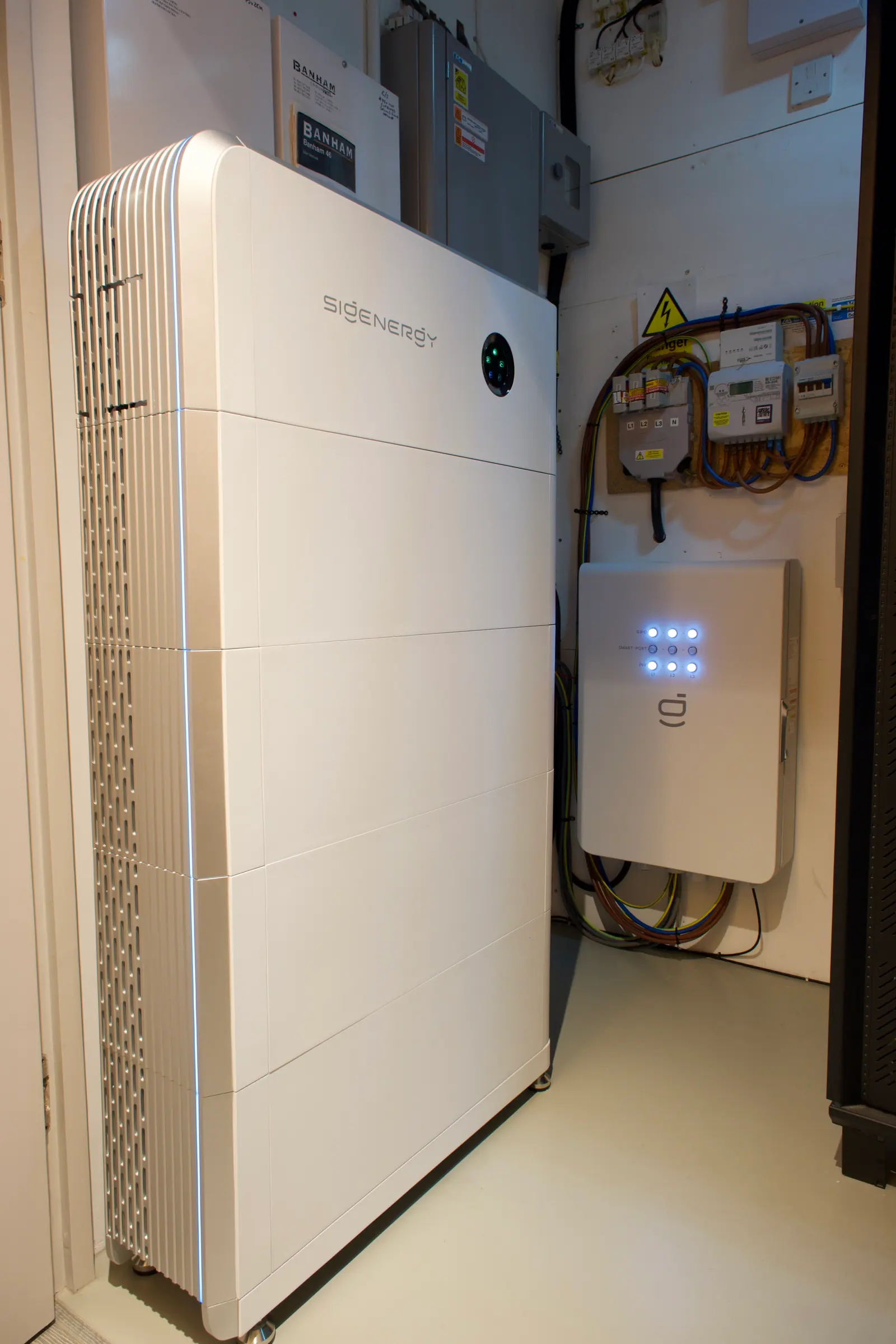
The battery sits in a cabinet on a wall or on the floor, in a garage, utility room or outside. An inverter, either built in or alongside, turns its stored direct current into the alternating current your home runs on. A control system decides when to charge and when to discharge, and you can see and change it on your phone. Battery size is measured in kilowatt hours, written kWh: the amount of energy it can hold.
We fit batteries from Sigenergy and Fox ESS. In Epsom we installed a 9 kWh Sigenergy SigenStor. In London we paired 5.5 kW of solar with 31 kWh of storage, a Sigenergy gateway and a myenergi eddi that sends spare solar to the hot water cylinder, in this London home.
Cost and VAT
The price depends on the size of the battery, the make, whether you already have solar and how easy the wiring is. We give a fixed quote after the survey, itemised so you can see what each part costs. We do not print savings or payback figures here, because they depend on your usage and on tariffs that change often.
Getting a quote? Fill in our solar and battery checklist first, so we can size your battery before we visit.
- 0% VAT. The supply and installation of a battery in a home is zero-rated for VAT in Great Britain until 31 March 2027. Since 1 February 2024 that includes a standalone battery with no solar, and a battery added to an existing solar system. The rate is due to return to 5% from 1 April 2027.
- Grants and schemes. If a grant or scheme could apply to your home, we check your eligibility at the survey. We do not promise it before then.
Figures reviewed 18 September 2026.
Batteries and the rest of your home
A battery does most when it works with the other systems in the house. With solar panels it keeps your daytime generation for the evening. With an EV charger it can help charge the car from stored solar or cheap overnight power. It can also run air conditioning or a heat pump on power you stored earlier. We design the battery with those in mind, so it has the right size and the right connections for what you add later.
Pros and cons
Pros
- Keeps your spare solar in the house for the evening instead of sending it to the grid
- Can charge from a cheaper overnight tariff and run the house through the expensive hours
- No VAT on the supply and installation of a home battery until 31 March 2027, with or without solar
- Can be added to an existing solar system without replacing the panels
- Lets you see and control where your power comes from on a phone app
Cons
- The upfront cost is real, and payback depends on your usage and your tariff
- A battery only saves money if there is a gap between the price you charge at and the price you avoid
- Tariffs change, so the savings you plan for today can shift later
- It needs a sensible spot, such as a garage, utility room or outside wall, with room around it
- A battery that is too big for your usage costs more and sits partly empty
Who it suits
- Homes with solar panels that export a lot of power during the day
- Households on, or willing to move to, a time-of-use or overnight tariff
- Homes with an electric car or a heat pump, which use a lot of electricity
- Owners planning solar now who want the battery designed in from the start
What is included in a Bespoke installation
- A survey of your home, your meter, your consumer unit and where the battery can go
- A look at your electricity bills or smart meter data to size the battery to your usage
- Supply of the battery and inverter or gateway from named manufacturers such as Sigenergy and Fox ESS
- Installation, electrical connection and commissioning by our own team
- DNO notification where the connection needs it
- The app set up on your phone and a walk through the settings before we leave
Frequently asked questions
Is a home battery worth it without solar panels?
It can be, if you are on a tariff with a cheap overnight rate. The battery charges while power is cheap and runs the house when it is dear. Whether it pays back depends on your usage and the gap between the two prices, so we look at your bills before we recommend one.
Can I add a battery to my existing solar panels?
Usually, yes. We check your current inverter and wiring at the survey. Some systems take a battery straight away, and others need a new hybrid inverter or a battery with its own inverter.
What size battery do I need?
It depends on how much power you use in the evening and overnight, how much solar you generate, and your tariff. Our Epsom job used a 9 kWh battery and our London job 31 kWh, which shows how wide the range is. We size it from your own figures, not a rule of thumb.
Is there VAT on a home battery?
Not at the moment. The supply and installation of a battery in a home is zero-rated for VAT in Great Britain until 31 March 2027, and that includes standalone batteries since 1 February 2024. The rate is due to return to 5% from 1 April 2027. We show the VAT treatment on every quote.
Figures reviewed 18 September 2026.